When travelers think of the Venice islands, they often imagine colorful houses, lace-making traditions, and peaceful vineyards. Yet hidden among the lagoon’s waters lies another powerful story — one of fortresses, arsenals, gunpowder depots, and naval dominance.
For centuries, Venice was not only a mercantile republic but also one of the greatest maritime powers in the Mediterranean. Its survival depended on controlling the sea. The lagoon was not just a scenic backdrop; it was a defensive shield, carefully engineered and fiercely protected.
A boat journey through Venice’s military lagoon reveals a hidden dimension of the Venice islands — an itinerary designed for history enthusiasts, architecture lovers, and anyone fascinated by fortified landscapes rarely seen by tourists.
Venice: A Naval Superpower Built on Water
From the Middle Ages through the Renaissance, the Republic of Venice dominated trade routes stretching from Europe to the East. Its wealth was protected by a formidable navy and an intricate defensive system designed to prevent enemy ships from entering the lagoon.
The Venice islands were strategically positioned as part of this system. Forts guarded the inlets, arsenals built ships at unprecedented speed, and powder magazines stored the materials necessary for defense.
Exploring these sites by boat is essential. Many of them were designed to be approached from the water — their imposing facades and defensive walls fully visible only from the lagoon itself.
Forte Sant’Andrea: Guardian of the Northern Lagoon
Located near the Lido inlet, Forte Sant’Andrea stands as one of the most impressive Renaissance fortifications among the Venice islands.
Built in the 16th century to defend the lagoon from naval attacks, the fort controlled access through the main sea entrance. Its thick brick walls, angular bastions, and strategic position allowed Venetian forces to monitor and block hostile ships attempting to enter.
Approaching Forte Sant’Andrea by boat reveals its true scale and purpose. From the water, you can appreciate the geometry of its defensive design — a masterpiece of military architecture influenced by Renaissance engineering principles.
It is a powerful reminder that Venice’s beauty was protected by calculated strength.
Forte Marghera: The 19th-Century Defensive Expansion
Moving toward the mainland side of the lagoon, Forte Marghera represents a later chapter in Venetian military history. Constructed during the Napoleonic and Austrian periods, it formed part of a broader defensive network designed to protect the region from modern artillery and land-based attacks.
Unlike earlier fortifications focused on maritime threats, Forte Marghera reflects evolving military strategies. Its earthworks, moats, and polygonal structures reveal the adaptation of defense systems to new technologies.
Although often overlooked by tourists, this site is a crucial piece of the story of the Venice islands as a fortified system — demonstrating how control of both land and water was vital for security.
Tesa 105: Industrial Power of the Arsenale
At the heart of Venice’s naval supremacy stood the Arsenale — one of the largest industrial complexes of pre-modern Europe.
Within this vast shipbuilding hub, structures like Tesa 105 played a fundamental role. These long covered buildings were used for constructing and maintaining ships, storing materials, and organizing naval production.
The Arsenale was capable of assembling a galley in a single day thanks to its advanced production methods — centuries before the Industrial Revolution introduced assembly-line techniques elsewhere in Europe.
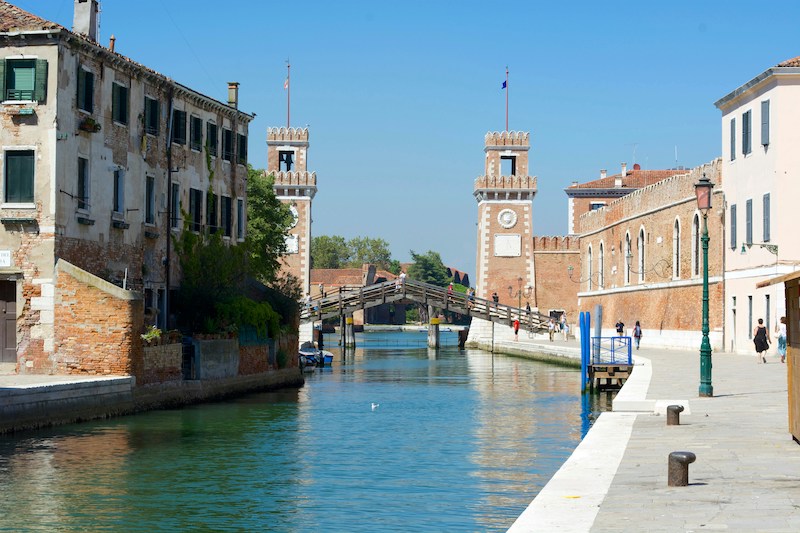
Viewing the Arsenale from the canal offers a privileged perspective. Its massive walls and monumental gates were designed to protect state secrets. Much of its activity was hidden from public view, reinforcing Venice’s reputation for strategic discretion.
Among the Venice islands, the Arsenale represents the beating heart of maritime power — a place where commerce and military strength merged.
Polveriere della Certosa: The Gunpowder Island
On the island of Certosa lies another lesser-known military site: the Polveriere, or gunpowder storage area.
Separated from populated areas for safety reasons, these depots were critical to Venice’s defense strategy. Gunpowder was stored away from the city center to minimize risk in case of accidental explosions.
The Polveriere della Certosa illustrates how even quieter Venice islands had strategic roles. Today, the island is also known for environmental regeneration projects, creating a striking contrast between its past military function and its present ecological focus.
This dual identity reflects the layered history of the lagoon — where fortifications and forests coexist.
The Arsenale from the Water: A Secretive Power
No military itinerary among the Venice islands would be complete without viewing the Arsenale from the water.
The monumental Porta Magna, guarded by stone lions, once marked the entrance to a highly restricted area. Shipbuilders, craftsmen, and naval officers worked behind its walls to produce the fleet that allowed Venice to dominate Mediterranean trade.
From the canal, the scale of the complex becomes evident. Long brick façades, defensive towers, and vast internal docks speak of a city organized around naval efficiency.
This water-level perspective reveals why Venice was considered nearly impregnable for centuries. The lagoon itself functioned as a natural moat, while the Arsenale ensured rapid military response.
The Lagoon as a Defensive Machine
What makes this journey unique is understanding that the entire lagoon was engineered as a defensive system. Channels were carefully maintained or redirected. Sandbanks were monitored. Forts were positioned to create crossfire zones at critical entry points.
The Venice islands were not isolated communities but interconnected components of a larger strategic design. Together, they formed a protective network that allowed Venice to thrive economically and politically for over a thousand years.
Exploring these structures by boat restores their original context. From land, many appear quiet or even abandoned. From the water, their strategic alignment becomes clear.
A Hidden Side of Venice
While millions visit Venice each year for its art and romance, few explore its military heritage. Yet this dimension is essential to understanding how the Republic maintained independence and wealth for centuries.
This historical-military itinerary offers a compelling alternative for travelers seeking depth beyond the usual attractions. It is particularly fascinating for:
- History enthusiasts
- Admirers of fortified architecture
- Naval history scholars
- Photographers interested in industrial and defensive landscapes
The Venice islands tell a story not only of beauty but of vigilance, innovation, and power.
Discover Venice’s Naval Secrets by Boat
To truly appreciate Venice as a maritime superpower, one must explore the lagoon by water — the same element that made its dominance possible.
A boat journey through Forte Sant’Andrea, Forte Marghera, Tesa 105, the Polveriere della Certosa, and the Arsenale canal reveals a forgotten narrative — one of strategy, engineering, and naval mastery.
For those wishing to experience this unique perspective across the Venice islands, organized lagoon excursions and transfers are available through Serenissima Tour, a historic Venetian company operating since 1924.
Discover more about routes and experiences here:
👉 https://serenissimatour.it/en/
Because beyond the palaces and piazzas lies another Venice — a powerful maritime republic whose secrets are still written across the waters of its lagoon.