Once a year, the Grand Canal reminds everyone what Venice has always been: a city built around the water.
On 6 September 2026, the Regata Storica returns to Venice, filling the Grand Canal with traditional boats, historic costumes, competitive rowing and one of the most extraordinary spectacles in the Venetian calendar.
For visitors, it is certainly an event worth seeing. But the Regata Storica can also be something more: an invitation to look at Venice from a different perspective.
Because to truly understand Venice, you have to follow the water.
Venice Was Never Meant to Be Explored Only on Foot
Today, discovering Venice often means walking through calli, crossing bridges and moving from one famous landmark to another.
For centuries, however, the water was Venice’s real network of streets.
Boats carried people, goods and news. Palaces were designed with their most important entrances facing the canals. Communities developed across the lagoon, connected to one another by waterways rather than roads.
The Regata Storica brings this relationship dramatically back into view.
As traditional boats move along the Grand Canal and rowers compete using techniques passed down through generations, Venice temporarily feels closer to the maritime city it has always been.
And that story does not end at the Grand Canal.
It continues across the lagoon.
From the Grand Canal to the Venetian Lagoon
Look beyond Venice’s historic centre and another landscape begins to emerge: bell towers on the horizon, small islands, fishing communities and centuries-old traditions shaped by life on the water.
This is the wider Venice that many travellers never fully discover.
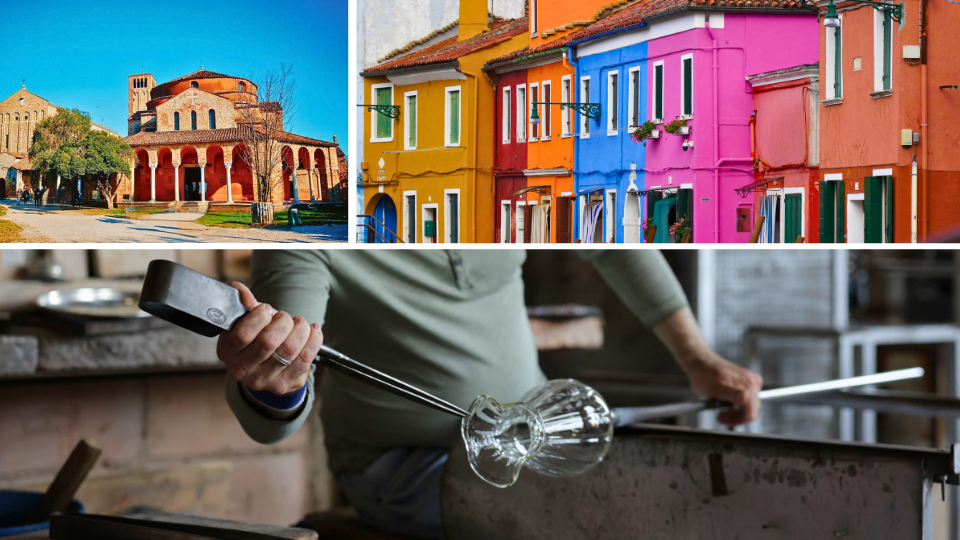
Murano, Burano and Torcello each reveal a different chapter of the lagoon’s history.
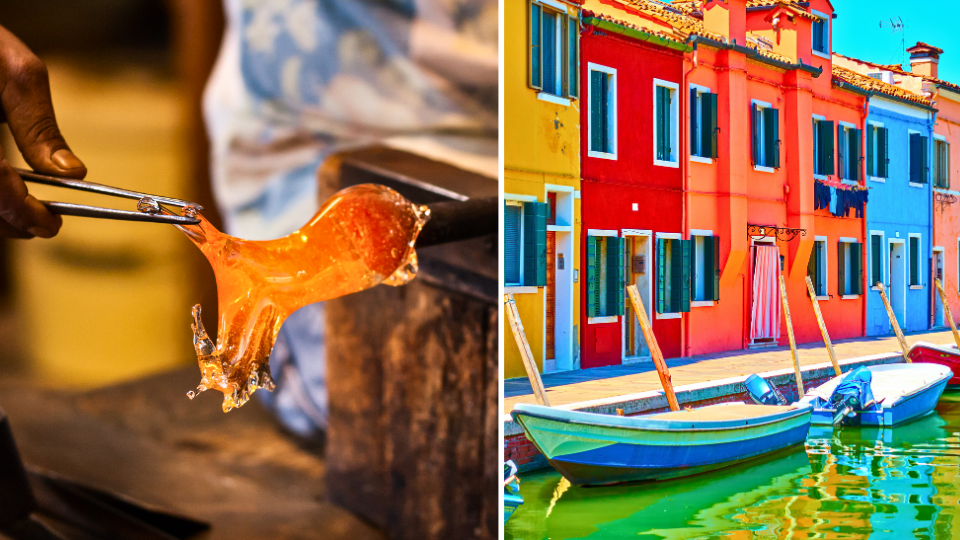
Murano tells a story of fire and craftsmanship. Its glassmaking tradition has become famous throughout the world, yet it remains inseparable from the history of the Venetian Lagoon.
Burano offers an entirely different atmosphere. Its brightly coloured houses, canals and lace-making tradition reflect the character of an island community with an identity all its own.
Then there is Torcello.
Quiet and green today, Torcello takes visitors much further back in the history of the lagoon. Long before Venice became the extraordinary city we know, settlements on islands such as Torcello were already shaping life in these waters.
Together, the islands help explain something that the Regata Storica makes particularly visible: Venice is not simply a city surrounded by a lagoon. Venice exists because of the lagoon.
A Century of Seeing Venice from the Water
There is a natural connection between the Regata Storica and Serenissima Tour: both tell a story of Venice that begins on the water.
That story has been part of our journey since 1924, when Serenissima Motoscafi began taking visitors across the Venetian Lagoon, opening the way to a new way of discovering Venice and its islands.
More than a century later, Serenissima Tour continues that tradition, inviting travellers to experience Venice as it has always been experienced: from the water. From the city to Murano, Burano and Torcello, every journey across the lagoon becomes an opportunity to discover the landscapes, traditions and heritage that make Venice unique.
Make the Regata Storica the Beginning of Your Journey
If you are visiting Venice for the Regata Storica 2026, don’t think of the event as the end of the experience.
Think of it as the beginning.
Watch the boats on the Grand Canal. Notice the rowing traditions, the historic vessels and the extraordinary relationship between the city and the water.
Then follow that story beyond Venice itself.
Sail towards Murano, Burano and Torcello and discover how different communities, crafts and traditions developed across the same lagoon.
In a city where almost every great story begins on the water, sometimes the best way to discover Venice is simply to keep sailing.
Regata Storica 2026 is your invitation to see Venice differently. Continue the journey across the lagoon with Serenissima Tour.